


 Cart
Cart
 sales@molnova.com


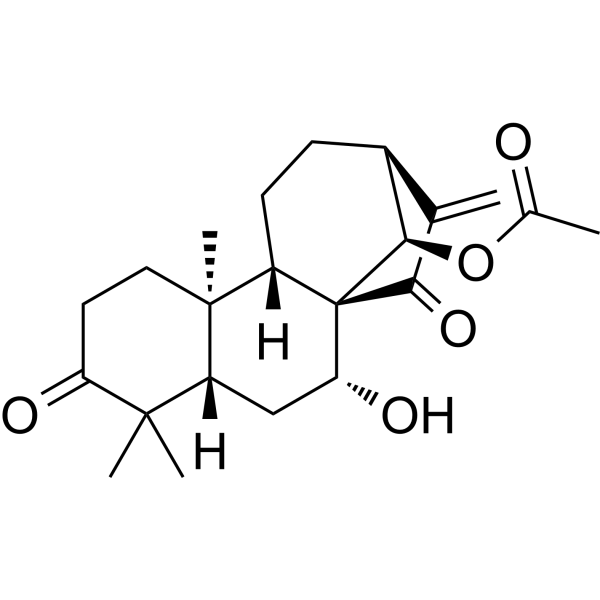
Glaucocalyxin B
CAS No. 80508-81-2
Glaucocalyxin B( —— )
Catalog No. M29628 CAS No. 80508-81-2
Glaucocalyxin B is a diterpenoid isolated from Rabdosia japonica with anticancer and antitumor activity. It decreases the growth of HL-60 cells (IC50: 5.86 μM).
Purity : >98% (HPLC)
 COA
Datasheet
HNMR
HPLC
MSDS
Handing Instructions
COA
Datasheet
HNMR
HPLC
MSDS
Handing Instructions
| Size | Price / USD | Stock | Quantity |
| 5MG | 329 | Get Quote |


|
| 100MG | Get Quote | Get Quote |
|
| 200MG | Get Quote | Get Quote |
|
| 500MG | Get Quote | Get Quote |
|
| 1G | Get Quote | Get Quote |
|
Biological Information
-
Product NameGlaucocalyxin B
-
NoteResearch use only, not for human use.
-
Brief DescriptionGlaucocalyxin B is a diterpenoid isolated from Rabdosia japonica with anticancer and antitumor activity. It decreases the growth of HL-60 cells (IC50: 5.86 μM).
-
DescriptionGlaucocalyxin B is a diterpenoid isolated from Rabdosia japonica with anticancer and antitumor activity. It decreases the growth of HL-60 cells (IC50: 5.86 μM).(In Vitro):Glaucocalyxin A (GlnA) and (GlnB) dose-dependently decrease the growth of HL-60 cells (IC50s: 6.15 and 5.86 μM at 24 h). Both Gln A and B could induce apoptosis, G2/M-phase cycle arrest, DNA damage and the accumulation of reactive oxygen species (ROS) in HL-60 cells. GlnB inhibits the proliferation of human cervical cancer cells in vitro through the induction of apoptosis and autophagy, which may be mediated by the phosphatidylinositol 4,5 bisphosphate 3 kinase/Akt signaling pathway. Treatment with GlnB inhibits the proliferation of HeLa and SiHa cervical cancer cell lines in a dose-dependent manner. GlnB increases the apoptotic cell population and enhanced poly (ADP ribose) polymerase 1 cleavage .
-
In VitroGlaucocalyxin A (GlnA) and (GlnB) dose-dependently decrease the growth of HL-60 cells with an IC50 of approximately 6.15 and 5.86 μM at 24 h, respectively. Both Gln A and B could induce apoptosis, G2/M-phase cycle arrest, DNA damage and the accumulation of reactive oxygen species (ROS) in HL-60 cells. GlnB inhibits the proliferation of human cervical cancer cells in vitro through the induction of apoptosis andautophagy, which may be mediated by the phosphatidylinositol 4,5 bisphosphate 3 kinase/Akt signaling pathway. Treatment with GlnB inhibits the proliferation of HeLa and SiHa cervical cancer cell lines in a dose dependent manner. GlnB increases the apoptotic cell population of and enhanced poly (ADP ribose) polymerase 1 cleavage. GlnB also induces increased light chain 3 II/I protein cleavage, indicating the induction of autophagy. GlnB treatment increases the expression of phosphatase and tensin homolog and decreases the expression of phosphorylated protein kinase B. Glaucocalyxin B (GLB), one of five ent-kauranoid diterpenoids, significantly decreased the generation of nitric oxide (NO), tumor necrosis factor (TNF)-α, interleukin (IL)-1β, cyclooxygenase (COX)-2 and inducible nitric oxide synthase (iNOS) in the lipopolysaccharide (LPS)-activated microglia cells.
-
In Vivo——
-
Synonyms——
-
PathwayAutophagy
-
TargetAutophagy
-
RecptorAutophagy
-
Research Area——
-
Indication——
Chemical Information
-
CAS Number80508-81-2
-
Formula Weight374.477
-
Molecular FormulaC22H30O5
-
Purity>98% (HPLC)
-
SolubilityIn Vitro:?DMSO : 100 mg/mL (267.04 mM)
-
SMILES[H][C@@]12CCC3[C@@H](OC(C)=O)[C@@]1(C(O)C[C@]1([H])C(C)(C)C(=O)CC[C@@]21C)C(=O)C3=C
-
Chemical Name——
Shipping & Storage Information
-
Storage(-20℃)
-
ShippingWith Ice Pack
-
Stability≥ 2 years
Reference
molnova catalog



related products
-
XRK3F2
XRK3F2 is a specific ZZ-domain of ubiquitin-binding protein p62 (Sequestosome 1) inhibitor that inhibits MM cell growth and BMSC growth enhancement of human MM cells.
-
Lys05
Lys05 (Lys01 trihydrochloride, PS-1001)?is the water-soluble salt of Lys01, is a 10-fold more potent lysosomal autophagy inhibitor than hydroxychloroquine (HCQ); shows IC50 values of 3.6, 3.8, 6 and 7.9 uM for 1205Lu, c8161, LN229 and HT-29 cell line in the MTT assay.
-
MRT68921 HCl
MRT68921 hydrochloride is a potent inhibitor of both ULK1 and ULK2 (IC50s: 2.9 and 1.1 nM respectively).
